











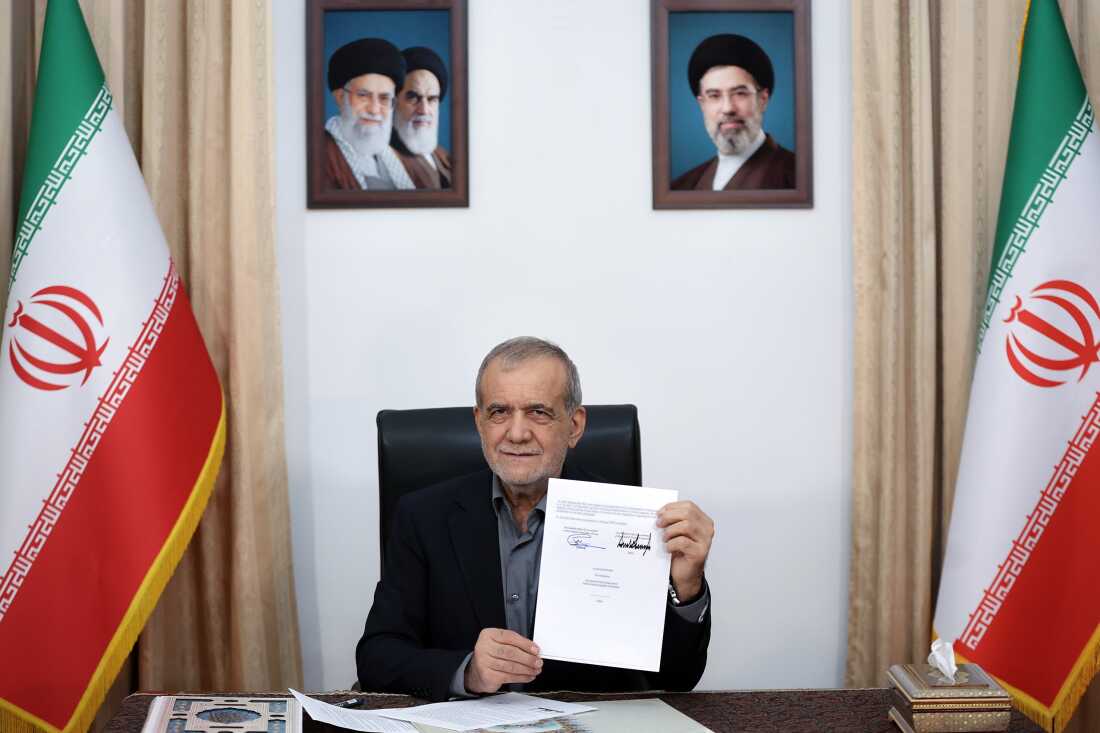

In a significant move, Iranian President Masoud Pezeshkian showcased a memorandum of understanding signed with U.S. President Trump, aimed at ending the ongoing war and initiating broader negotiations. This announcement was made in Tehran early Thursday, as Vice President JD Vance postponed his trip to Switzerland, where he was set to negotiate the peace agreement with Iran. The last-minute delay has raised concerns about the stability of the memorandum, especially as journalists awaited updates in Lucerne.
The agreement was signed amid continued hostilities, with Israeli forces heavily bombarding Lebanon despite commitments to cease military operations. Reports indicate that at least 18 individuals were killed in Israel’s latest strikes, while four Israeli soldiers lost their lives in southern Lebanon. The conflict has already claimed thousands of lives across the Middle East and severely impacted global economies, pushing millions into poverty, as highlighted by the United Nations.
The memorandum of understanding aims to end military operations on all fronts and reopen the crucial Strait of Hormuz, a vital passage for global oil, gas, and fertilizer shipments. President Trump celebrated the agreement on Truth Social, stating, “Ships of the World, start your engines. Let the oil flow!” However, he also emphasized the fragility of the deal, asserting that if either side fails to adhere, military action could resume.
While the agreement establishes a 60-day window for resolving longstanding tensions between the U.S. and Iran, it does not address the fundamental issues that led to the conflict. Israeli Prime Minister Benjamin Netanyahu has maintained that Israeli troops will remain in southern Lebanon until security concerns are resolved, further complicating the situation.
Iranian Foreign Minister Abbas Araghchi has insisted that Israel’s withdrawal from occupied territories is essential for a full resolution to the war. The Israeli government has expressed skepticism about the agreement, with far-right national security minister Itamar Ben-Gvir stating, “Trump’s agreement does not bind us.” Meanwhile, Vice President Vance defended Trump, asserting that he is currently the only sympathetic leader for Israel.
The memorandum promises an immediate and permanent halt to military operations, including those in Lebanon, and reiterates that neither Iran nor the U.S. will initiate further conflict. Following the signing, U.S. Central Command announced the end of its naval blockade on Iranian ports. Iranian state media reported that Iran’s national security council would suspend tolls for ships for 60 days, though vessels must still seek permission to cross the Strait of Hormuz.
The agreement has implications for Trump’s domestic approval ratings, which have been affected by rising gasoline prices and inflation. Although Trump has downplayed the economic situation in his approach to Iran, he acknowledged the necessity of the agreement to avoid an economic catastrophe.
In a surprising twist, the framework provided in this preliminary deal includes substantial financial concessions for Iran, potentially surpassing those granted in the Obama-era Joint Comprehensive Plan of Action (JCPOA). The U.S. has committed to collaborating with regional partners to establish a fund of “at least $300 billion” for Iran’s reconstruction and economic development, while also unfreezing Iranian assets that could amount to tens of billions of dollars.
Despite the preliminary nature of the agreement, Trump has asserted that it will lead to a far superior outcome compared to the JCPOA. The negotiations are set to continue, but it remains uncertain whether Iran will provide any more concessions than previously offered. The situation is further complicated by Iran’s demonstrated ability to influence global economic stability, particularly through its control of the Strait of Hormuz.
As new talks are anticipated, both sides will need to navigate the complexities of their longstanding enmity, with Iran poised to come to the table having showcased its significant leverage amidst the ongoing geopolitical tensions.
Source World News.